—
It was after midnight at a small-town Texas gun store. Two men — a state lawmaker and a congressional candidate — were purchasing suppressors in the presence of a congressman and top officials of a pro-Second Amendment organization.
Just hours before, the congressman learned the Trump administration would abide by one of the most consequential Second Amendment rulings in over 90 years. The men proceeded to make history, becoming the first Americans to purchase suppressors without registration since Franklin Delano Roosevelt was president.
The entire story that led to this historic moment hasn’t been told. Until now.
The Daily Caller News Foundation interviewed several key players involved in making this long-sought Second Amendment victory a reality. From the halls of Congress, to the chambers of justice and finally to a Texas gun store, this is the inside account of what led to one of the most significant moments for the Second Amendment community since 1934. (RELATED: Pro-2A Organization Fires First Salvo In Supreme Court Battle Over Semi-Auto Gun Bans)
“Top Secret” Plan Hatched
Gun Owners of America (GOA) Federal Affairs Director Aidan Johnston told the DCNF that the origins of the battle happened years before the group launched its “top secret” effort.
“We did a lot of behind the scenes lobbying for about six months… all of this had to be top secret,” Johnston told the DCNF. “We didn’t want the Democrats or the anti-gunners to get any word of what we were planning on the big beautiful bill.”
Covert Classes For Congress
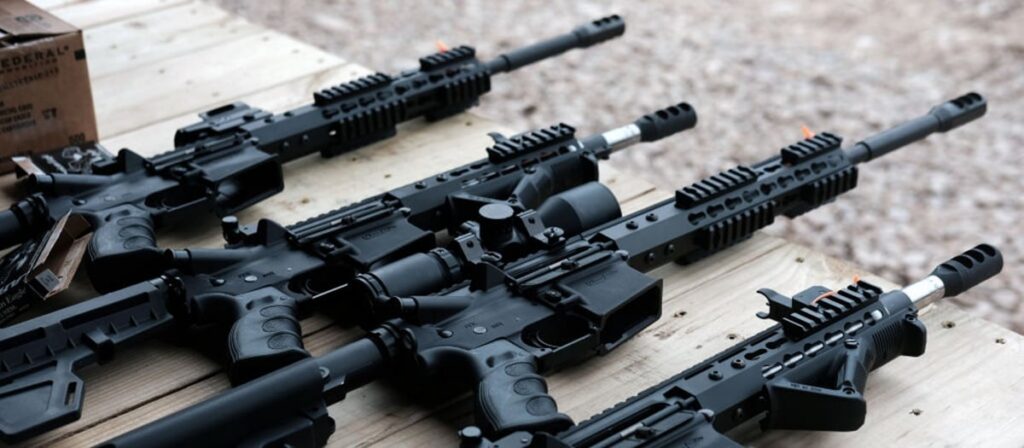
“GOA was locked in and we knew our chance to get something done on guns this Congress was going to have to do with taxes, and there’s only two gun taxes out there: The National Firearms Act, which is a $200 tax on silencers, short-barreled rifles, short-barreled shotguns, [any other weapons [AOWs)], machine guns, and destructive devices, and then there’s like this Pittman Robertson tax on all guns and ammunition at 10% and 11%,” Johnston told the DCNF in an interview. “And so we decided we wanted to target the silencer regulations, the silencer tax, and the short barrel stuff, especially because President [Joe] Biden had weaponized the short barrel rifle statute in order to ban millions of pistol brace weapons.”
Pistol braces were originally popularized among disabled shooters, notably veterans, to better handle AR-15-style pistols in the early 2010s. The Bureau of Alcohol, Tobacco, Firearms, and Explosives (ATF) had no problem with the devices at first, considering them legal – even if someone was firing them from the shoulder — before changing its tune in 2015, according to ConcealedCarry.com.
In June 2020, then-Republican Florida Rep. Matt Gaetz accused the ATF of secretly plotting regulations targeting the devices. Gaetz did not respond to multiple requests for comment from the DCNF.
With a change in presidential administrations came a change in attitude toward the devices. In 2021, the Biden administration began pushing to classify the items as “short-barreled rifles” under the NFA, and issued a final regulation to that effect in January 2023, giving those who owned firearms with those devices 120 days to register them with ATF in an “amnesty” before they would face a potential ten-year prison sentence.
Pro-Second Amendment groups challenged the regulation in court almost immediately, eventually securing court orders blocking it. However, they also began to eye a legislative fix to the issue once President Donald Trump won a second term.
“One thing we could do is we could work with the [second Trump] administration to undo that regulation,” Johnston said. “The other thing we could do is just nullify that statute, try to repeal that statute.”
Despite the straightforward nature of the plan, GOA didn’t want to broadcast their intentions and risk pushback from anti-Second Amendment organizations. Therefore, it didn’t openly discuss any moves pertaining to federal legislation regarding suppressors or other items covered by the National Firearms Act in its national alerts at the start of the 119th Congress.
In the House of Representatives, Republican Georgia Rep. Andrew Clyde, who sponsored the SHORT Act, was pushing for the legislative language for both his legislation and for the Hearing Protection Act introduced by Republican Virginia Rep. Ben Cline. Clyde considered his biggest challenge to be overcoming a lack of knowledge among his GOP colleagues as opposed to opposition from Democrats.
“I think that was probably the biggest challenge, helping folks to understand exactly what the National Firearms Act had been doing literally for 90 years. I mean, the taxes were used punitively. In 1934, a suppressor was like $6, $6.50, okay?” Clyde told the DCNF. “Well, you put a $200 tax on something [that’s] $6.50, it eliminates it. And that’s exactly what happened, you know? So helping people understand exactly what the taxes had done. I mean, even today, short-barreled firearms, like a short-barreled shotgun, all right, $400 with a $200 tax.”
The House of Representatives passed its version of the bill which contained language removing silencers from the purview of the National Firearms Act on May 22, 2025. The legislation then went to the Senate, where before it was taken up, Senate Parliamentarian Elizabeth MacDonough reviewed it to determine if provisions violated the so-called “Byrd rule,” a process called the “Byrd bath.”
Under Section 313 of the Congressional Budget and Impoundment Control Act of 1974, while budget reconciliation bills bypass the Senate’s filibuster, they must not include “extraneous” provisions that do not affect revenue or outlays, according to a Congressional Research Service report. During the “Byrd bath” for the One Big Beautiful Bill, MacDonough found that the silencer provision violated the “Byrd rule,” a decision that stoked controversy. Republican Utah Sen. Mike Lee told the DCNF he was “initially annoyed” about the ruling from MacDonough.
“Excessive deference to the Parliamentarian keeping good legislation down is an old, familiar story in the Senate,” Lee said. The frustration was also tangible when a pro-Second Amendment activist recounted the ruling.
“This is a parliamentarian who was originally hired by [former Senate Majority Leader] Harry Reid,” Johnston told the DCNF. “So why does John Thune have a Harry Reid bureaucrat working for him? I don’t know.”
Clyde worked with Republican senators, including Lee, to get final legislative language that took the tax on suppressors, short-barreled rifles, short-barreled shotguns and devices that fell under the label “any other weapon” down to $0. The provision was placed into the Senate version of the bill, and it passed the Senate on July 1, 2025, in a 51-50 vote (Vice President J.D. Vance broke the tie in his role as president of the Senate).
After the House concurred with the Senate amendment on July 3, 2025, in a 218-214 vote, it presented the legislation to Trump, who signed it into law on July 4, 2025. That same day, GOA filed a lawsuit in the United States District Court for the Northern District of Texas.
Litigation Ends With Shot Heard Round Second Amendment Community
The GOA lawsuit was not the only one. Other pro-Second Amendment organizations, including the Second Amendment Foundation (SAF), Firearms Policy Coalition (FPC), Texas State Rifle Association (TSRA), National Rifle Association (NRA), Jews for the Preservation of Firearms Ownership (JPFO) and the American Suppressor Association filed a trio of lawsuits against the NFA, one in Texas (Jensen v. ATF), one in Missouri (Brown v. ATF) and one in Kentucky (Roberts v. ATF).
“When the One Big Beautiful Bill was signed and the tax requirement for short-barrel rifles, short barrel shotguns, AOWs and suppressors went to zero, that’s what made our legal challenges possible because our legal theory was that, or it is that, remains that, that the NFA itself is a tax provision and that the regulatory requirements associated with that that we challenged in these cases had to do with Congress’s taxing authority,” SAF Senior Director of Legal Operations Bill Sack told the DCNF. “That was the constitutional hook that Congress drew upon in passing the tax.”
“So, when the taxes were reduced to zero, then all of the remaining regulatory registration requirements were no longer constitutional under the Congress’s taxing authority because what Congress had maintained all along from the 1930s onward was that the registration requirements were not about registering the firearms