—
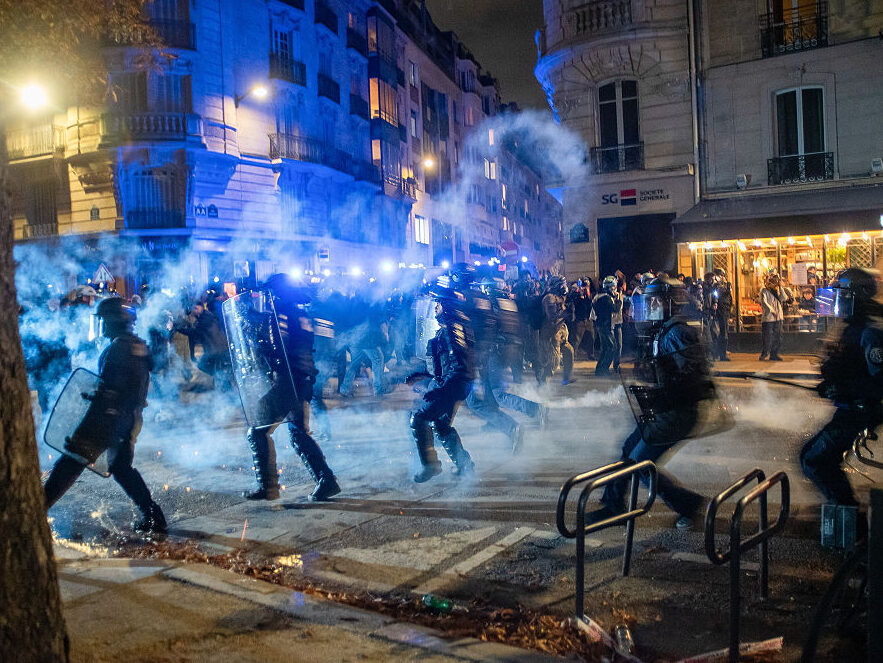
France was again rocked by a day of protests on ‘Black Thursday’, which saw nearly 600,000 people from student and worker union groups march, and over 100 police officers injured in clashes.
France’s autumn of discontent continues apace, with latest protests seeing disruption to transport and services nationwide, and more actions days of planned for the coming weeks. The Macron government’s Interior Ministry said in a statement on Friday morning that during the ‘Black Thursday’ protests yesterday they recorded 193 marches nationwide that saw 642 arrests and 86 fires.
The government’s estimates stated 575,000 people had joined Thursday’s protests, a comparatively modest figure to the 1.6 million people on the streets claimed by organising trade unions.
Demonstrators link arms and carry red flags beneath a banner calling for a general strike during a trade union demonstration in Paris, France, on November 5, 2026. (Photo by Clement Souchet/NurPhoto via Getty Images)
While the atmosphere of the protests was much more subdued than recent days of wild riot and looting — with French newspaper Le Figaro‘s analysis stating the “traditional atmosphere” of traditional French protest marches had returned — there were still a handful of serious clashes. Protesters scuffled with Police in Paris, and there were baton charges, stun grenades, and tear gas deployed in Rennes, Bordeaux, and Lyon. A school was burnt down near Toulouse.
Nevertheless, the active deployment of 70,000 officers appears to have helped prevent the extent of ugly scenes from earlier rallies. Yet limited violence or not, 112 police officers are said to have been injured on Thursday, with almost half of those casualties occurring through the evening.
The Thursday protests are another instance of the emerging phenomenon on the French left of coordinating otherwise disparate groups to a greater or lesser extent to protest together — or at least protest, riot, and loot on the same days to maximise strain on the police and government — a mission of the planners of these events that has been described as the “convergence of struggles”.
The involvement of trade unions in Thursday’s protests, which are older, more experienced campaigners than the white-hot rage of students and unassimilated migrants active otherwise in recent weeks, has seen the emergence of concrete demands associated with the marches. While demands, if any were articulated at all, were vague in previous weeks on Thursday they were said to be a ten per cent rise in the national minimum wage, a €10 billion boost in education funding, and for the resignation of the government.
A giant puppet of a CRS officer ablaze during the demonstration on 5 November in Strasbourg, France, on 5 November 2026.
Une marionnette geante de CRS en flamme lors de la manifestation du 5 novembre a Strasbourg France le 5 novembre 2026. (Photo by Tobias Canales / Hans Lucas / AFP via Getty Images)
Revolutionary aspirations aside, the use of the protests to boost the electoral prospects of the hard left also continued on Thursday. Top-polling presidential candidate of the hard-left LFI faction Jean-Luc Mélenchon made a personal appearance at the Paris march on Thursday, his arrival characterised as being “flanked by his lieutenants” as he was “greeted with great fanfare by a crowd of supporters chanting his name”.
It was stated that moments before his appearance, a majority of Communist lawmakers in France — a separate political party even to the left of the socialist politician — had declared their allegiance to Mélenchon, saying they would back him rather than the leader of their own party in next year’s presidential elections.
More protests are slated to follow. On Saturday, marches have been called in France and across Paris, and later this month on the weekend of the 20th, 21st, and 22nd, pan-European French-style protests have been announced. Representatives from leftist groups from the United Kingdom, France, Italy, Spain, Portugal, Belgium, and Greece met in Paris to discuss plans and agreed on coordination and demands, which are said to include funding for welfare, pro-migration policies, ending military equipment spending, taxing the wealthy, and environmental demands.